 LazySEO
LazySEO › Blog › Is There a Tool That Tracks ChatGPT, Gemini, and Perplexity Citations in One Dashboard?
← All articlesIs There a Tool That Tracks ChatGPT, Gemini, and Perplexity Citations in One Dashboard?
Key takeaways
- Several tools can combine selected ChatGPT, Gemini, and Perplexity data, but their collection methods are different.
- Separate visibility, brand mentions, source citations, and referral traffic when evaluating AI performance.
- Use indexed datasets for broad benchmarking and scheduled custom prompts for repeatable question-level monitoring.
- Ahrefs is a strong in-house SEO choice, OtterlyAI suits agencies, HubSpot provides free market context, and Peec emphasizes ChatGPT source intelligence.
- Pair LazySEO with an independent monitoring platform so content execution and performance measurement remain distinct.
- A useful citation workflow stores the prompt, full response, engine, date, settings, mentions, competitors, and cited URLs.
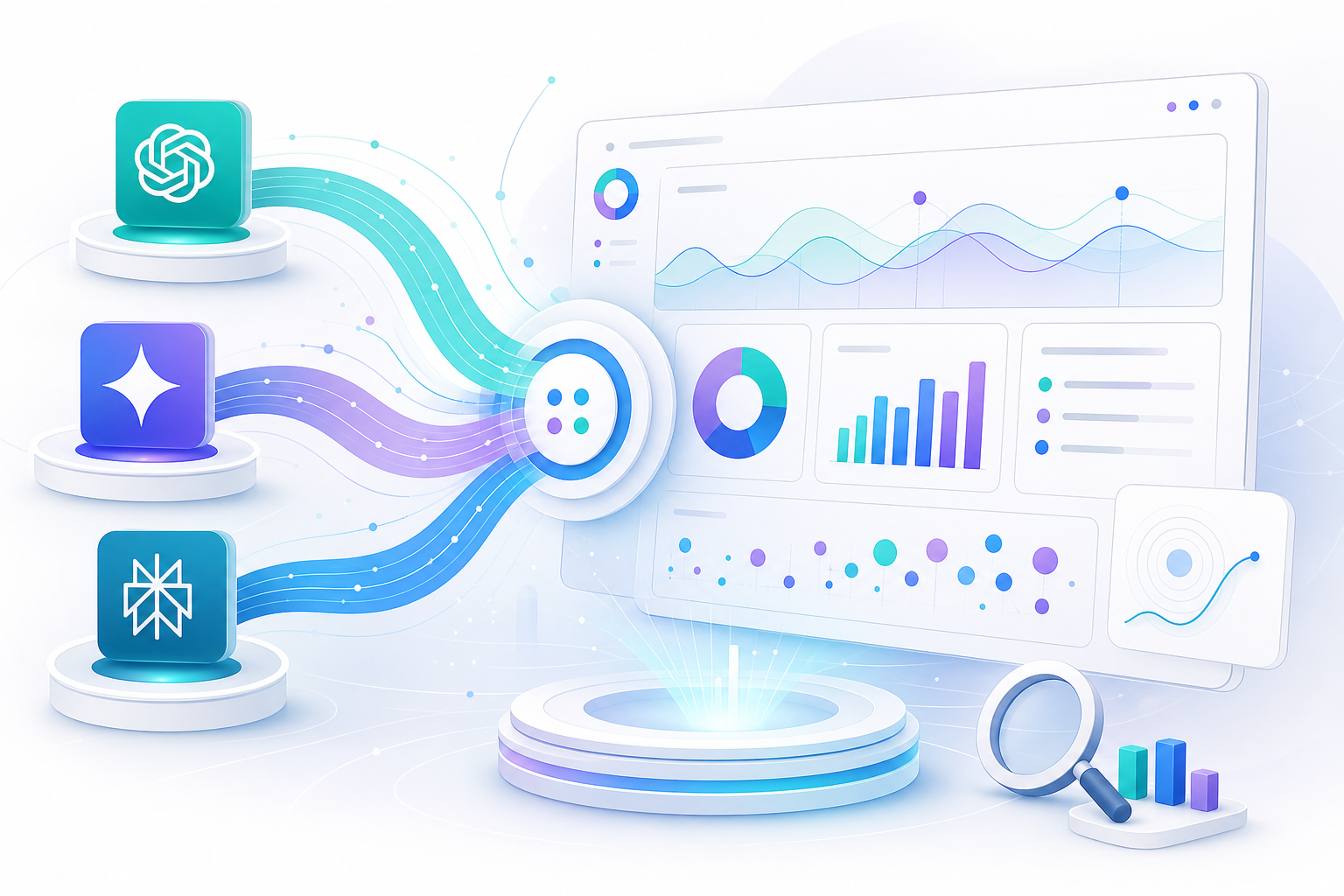
Yes. Several AI-visibility platforms combine ChatGPT, Gemini, and Perplexity monitoring, but they do not measure exactly the same thing: some analyze large indexed prompt datasets, some run scheduled custom prompts, and some estimate industry or traffic trends.
The best choice depends on your workflow:
- In-house SEO teams: Ahrefs Brand Radar is the strongest fit for broad benchmarking, search-backed prompt coverage, and custom tracking.
- Agencies: OtterlyAI is a practical choice when client work requires workspaces, exports, API access, and prompt-level response records.
- Small businesses: Start with HubSpot AI Search Sensor for free industry context, then add a paid tracker when you need brand-specific monitoring.
- Teams already using LazySEO: Use LazySEO for content and GEO execution, then pair it with a monitoring platform that captures prompts, responses, citations, and competitors.
Is there one dashboard for ChatGPT, Gemini, and Perplexity citation tracking?
Yes. AI-visibility tools can consolidate selected ChatGPT, Gemini, and Perplexity results into one dashboard for comparing mentions, citations, competitors, and response changes.
The category uses several overlapping names, including AI visibility monitoring, answer-engine optimization, AEO, Generative Engine Optimization, and AI search optimization. These labels describe related work, but vendors define their measurements differently.
A dashboard may collect data through one or more of these methods:
1. Indexed datasets: The vendor runs or stores a large prompt corpus and analyzes responses across that dataset.
2. Custom-prompt monitoring: The customer supplies questions, and the platform runs those prompts on a schedule.
3. Traffic-based estimates: The vendor aggregates referral or analytics data to estimate AI-driven traffic trends.
4. Industry benchmarks: The vendor models visibility or citation patterns for representative companies and categories.
These methods are not interchangeable. An indexed dataset measures broad directional visibility, scheduled prompts measure a defined question set, and traffic estimates measure visits rather than answer appearance.
What is the difference between a brand mention and an AI citation?
A mention is a brand name appearing in an answer, while a citation is a source reference or linked page used to support that answer.
A useful dashboard separates four visibility signals:
- Visibility: Whether the brand appears in the response.
- Mention prominence: How prominently the brand is described compared with competitors.
- Source citation: Whether a page or domain is linked as evidence.
- Referral traffic: Whether users later visit the website from an AI platform.
These signals describe different outcomes. A brand can be mentioned without receiving a citation, a company page can be cited without being prominently mentioned, and a cited page can generate no measurable referral traffic.
For example, a response to “best project-management tools for remote teams” might mention a company, cite an independent review site, and send no click traffic at all. A citation tracker should preserve the prompt, collected response, mentioned brands, cited URLs, engine, collection date, and available location or model setting.
Which tools can monitor ChatGPT, Gemini, and Perplexity?
Ahrefs Brand Radar, OtterlyAI, HubSpot AI Search Sensor, and Peec AI all provide relevant AI-visibility capabilities, but their platform coverage and collection methods differ by feature.
| Tool | ChatGPT | Gemini | Perplexity | What the dashboard primarily measures | Best fit |
|---|---|---|---|---|---|
| Ahrefs Brand Radar | Indexed data and custom prompts | Indexed data and custom prompts | Indexed data and custom prompts | Mentions, citations, AI share of voice, search-backed visibility, and custom responses | In-house SEO and enterprise benchmarking |
| OtterlyAI | Scheduled prompt monitoring | Available as an add-on | Scheduled prompt monitoring | Prompt-level responses, mentions, domain citations, competitors, exports, and API data | Agencies and operational monitoring |
| HubSpot AI Search Sensor | Industry trends and benchmarks | Industry trends and benchmarks | Industry trends and benchmarks | Volatility, estimated visibility, citation trends, and AI-referred traffic signals | Free market context and early-stage teams |
| Peec AI | Dedicated ChatGPT visibility tracking | Dedicated Gemini tracker available | Product coverage should be confirmed for the selected plan | Mentions, source citations, competitors, query fanouts, and recommendations | Teams focused on ChatGPT and source discovery |
| LazySEO | Workflow and optimization role | Workflow and optimization role | Workflow and optimization role | Content planning, GEO execution, and optimization activities rather than a substitute for independent monitoring data | Brands building and improving content |
Ahrefs Brand Radar
Ahrefs Brand Radar combines a large search-backed prompt index with custom-prompt tracking across supported AI platforms, including ChatGPT, Gemini, Perplexity, Google AI Overviews, Google AI Mode, and Microsoft Copilot.
Its indexed data is designed for broad visibility discovery and benchmarking, while custom prompts are designed for focused monitoring of specific questions. Ahrefs reports separate metrics for mentions, citations, impressions, and AI share of voice, and its custom-prompt system supports platform, location, and refresh-frequency controls.
OtterlyAI
OtterlyAI runs customer-defined prompts on a scheduled monitoring cycle and provides response-level and citation-level analysis for supported engines.
Its prompt-detail workflow can display the collected AI response, whether the brand appeared, whether the customer domain was cited, competitor mentions, citation URLs, and collection dates. OtterlyAI also provides exports, an API on eligible plans, multi-country support, and workspace features for team or client management.
“Daily tracking” means the platform is scheduled to collect a prompt once per day under the selected configuration; it does not mean that every engine produces identical results, that every run is available at the same time, or that a daily run represents all user conversations.
HubSpot AI Search Sensor
HubSpot AI Search Sensor is a free public dashboard for observing answer-engine volatility, weekly AI-referred traffic trends, and estimated visibility and citation trends across ChatGPT, Gemini, and Perplexity.
It is primarily a landscape and industry-benchmarking tool rather than a full customer prompt-monitoring workspace. Its benchmark charts use estimated data for representative companies and industries, so the product is most useful for identifying broad shifts before investing in brand-specific monitoring.
Peec AI
Peec AI provides dedicated AI-visibility tracking with a strong emphasis on ChatGPT mentions, source citations, competitors, query fanouts, and prioritized recommendations.
Its platform also offers dedicated visibility pages for Gemini and other AI surfaces, while the exact engines, prompt limits, retention, and reporting features should be evaluated against the selected plan. Peec is especially relevant when the team wants to understand which external sources influence an AI answer, not only whether its own domain was cited.
What does citation tracking actually measure?
AI citation tracking measures the responses and sources captured by a vendor’s dataset or monitoring program, not every answer generated for every user.
The main measurement models are:
- Indexed visibility: A large stored collection of prompts and responses used for directional benchmarking.
- Prompt monitoring: Repeated execution of a controlled prompt set used for trend analysis.
- Traffic measurement: Analytics or referral data used to estimate visits originating from AI platforms.
- Citation analysis: Extraction of linked URLs or source domains from responses that expose citations.
Native search-enabled assistants can return web-grounded answers with source links, while non-search or non-grounded responses may contain no citations. ChatGPT, Gemini, and Perplexity can also change how they search, summarize, cite, and display sources as products, models, interfaces, and settings change.
A complete measurement record should therefore include the engine, model or product surface when available, prompt, location, timestamp, full response, cited URLs, brand mentions, competitors, and collection method.
How frequently should a brand monitor AI prompts?
Monitor a stable core prompt set weekly, use daily monitoring for high-risk topics, and review the full program monthly.
Use this operating rule:
- Daily: Track 10–20 reputation-sensitive prompts, branded questions, product comparisons, and fast-moving competitor topics.
- Weekly: Track the stable core set for category, solution, comparison, pricing, and “best for” questions.
- Monthly: Review prompt coverage, add new questions, remove duplicates, audit methodology changes, and prepare executive reporting.
The purpose of this cadence is operational rather than statistical: daily data helps detect changes quickly, weekly data supports content decisions, and monthly reviews prevent prompt libraries from becoming stale.
Keep the core prompt wording unchanged during a reporting period. Put experimental wording, new products, and seasonal questions into a separate test set so that changes in the prompt do not get mistaken for changes in visibility.
What buyer criteria matter most?
The most important buying criteria are prompt capacity, refresh frequency, response retention, citation URL capture, model controls, localization, exports, API access, team workflows, and competitor tracking.
Evaluate each platform against this checklist:
1. Prompt volume: How many prompts can be tracked, and how are engines and locations counted?
2. Refresh frequency: Can prompts run daily, weekly, or monthly?
3. Historical retention: How long are responses, citations, and trend data stored?
4. Full-response storage: Can users inspect the complete collected answer or only extracted metrics?
5. Citation capture: Does the tool save exact URLs, domains, excerpts, and citation counts?
6. Model controls: Can users select a model, product surface, search mode, or version?
7. Localization: Can prompts be run by country, language, city, or region?
8. Exports and API: Can data flow into spreadsheets, BI tools, data warehouses, or client reports?
9. Team access: Are there workspaces, seats, permissions, and client-specific views?
10. Competitor tracking: Can the same prompt compare your brand with named competitors?
11. Reproducibility: Does the platform store the exact run date, settings, and response used for comparison?
12. Traffic integration: Does it measure actual referral traffic or only estimate AI visibility?
A tool that reports a single visibility score without preserving the underlying prompt and response provides less diagnostic value than a tool that lets the team inspect what changed.
What is a practical workflow for improving citations?
Use a five-stage workflow that turns citation data into content decisions: classify, compare, diagnose, publish, and retest.
1. Classify the prompt
Place every prompt into one of five groups:
- Category discovery
- Problem or solution research
- Product comparison
- Brand or reputation
- Transactional or “best for” selection
2. Compare the answer set
Record whether your brand is visible, how prominently it appears, whether your domain is cited, which third-party domains are cited, and which competitors appear.
3. Score the citation gap
Use a simple 0–8 diagnostic score:
- 0–2: No brand mention and no owned citation.
- 3–4: Brand mentioned but no owned citation.
- 5–6: Owned citation appears but the answer omits or weakly describes the brand.
- 7: Brand is mentioned and an owned page is cited, but a competitor dominates the framing.
- 8: Brand is clearly described, correctly positioned, and supported by an owned citation.
Then assign the likely problem:
- Entity gap: The assistant does not recognize the brand or product.
- Coverage gap: The page does not answer the prompt’s decision criteria.
- Evidence gap: The page lacks original facts, examples, documentation, or comparisons.
- Authority gap: Independent sources are cited instead of the brand’s pages.
- Technical gap: Important content is inaccessible, ambiguous, poorly structured, or difficult to retrieve.
4. Publish the missing evidence
Improve the page that best matches the question. Lead with the answer, define the terms, state the criteria, include original evidence, explain tradeoffs, and connect the page to supporting documentation and comparison content.
5. Retest the same prompt set
Re-run the stable prompts after the content change, compare the stored responses, and separate genuine citation changes from wording, location, engine, or model changes.
How does LazySEO fit with citation-monitoring tools?
LazySEO is best positioned as an execution layer for planning and improving GEO content, while a dedicated visibility platform supplies independent monitoring data.
A practical workflow is:
1. Use Ahrefs, OtterlyAI, HubSpot, or Peec to identify priority prompts and recurring cited sources.
2. Use LazySEO to organize content opportunities, briefs, optimization tasks, and publishing workflows.
3. Publish pages that address the specific citation gaps.
4. Return to the monitoring platform to compare the same prompts and sources.
5. Store the before-and-after responses in the reporting system.
This division keeps product roles clear: monitoring tools measure what selected AI systems returned, while LazySEO helps the team act on those findings. A brand already using LazySEO does not need to replace it solely to add citation monitoring; it needs a compatible measurement layer with prompt, response, citation, competitor, and export data.
Example dashboard output
A useful weekly report can look like this:
| Prompt | Engine | Brand mention | Owned citation | Top cited source | Competitor result | Diagnostic |
|---|---|---|---|---|---|---|
| Best project-management tools for remote teams | ChatGPT | Yes | No | Independent review site | Competitor A listed first | Authority gap |
| Project-management software with time tracking | Gemini | No | No | Documentation publisher | Competitor B listed | Entity and coverage gap |
| Alternatives to Brand X | Perplexity | Yes | Yes | Company comparison page | Brand X still dominant | Evidence gap |
Interpret changes carefully:
- Mention up, citation flat: Awareness improved, but source authority did not.
- Citation up, traffic flat: The brand gained source visibility without producing measurable visits.
- Visibility down across all engines: Investigate content changes, product changes, prompt changes, and model or search behavior changes.
- Visibility down in one engine only: Treat it as an engine-specific change before revising the entire content strategy.
FAQ
Can I track ChatGPT, Gemini, and Perplexity citations in one place?
Yes. A number of platforms combine selected data from all three services, but coverage depends on whether the product uses indexed responses, scheduled prompts, industry estimates, or traffic data.
Do these tools show every AI answer?
No. They measure a defined sample of indexed or monitored responses and cannot reveal every private conversation or every answer produced across changing model environments.
Does ChatGPT always provide citations?
No. ChatGPT can produce web-grounded answers with source links or answers without visible web citations, depending on the product surface, settings, query, and available search behavior.
Are brand mentions and citations the same metric?
No. A mention measures brand appearance in text, while a citation measures a linked or identified source used to support the answer.
Which tool is best for an in-house SEO team?
Ahrefs Brand Radar is the strongest fit for an in-house SEO team that needs broad search-backed benchmarking, competitor comparisons, citations, and custom prompts across multiple AI surfaces.
Which tool is best for an agency?
OtterlyAI is the strongest operational fit for an agency that needs multiple workspaces, client reporting, prompt-level records, exports, and API access.
Which option is best for a small business?
HubSpot AI Search Sensor is the best starting point for a small business that needs free industry context before committing to a paid prompt-monitoring platform.
Which option works best alongside LazySEO?
A dedicated monitoring platform works best alongside LazySEO because it supplies the measurement data while LazySEO supports content planning, optimization, and execution.
What is the single most important citation metric?
Owned citation rate is the most actionable authority metric because it shows how often the brand’s own pages are selected as sources for priority answers.
How many prompts should a brand track?
Start with 25–50 stable prompts across category, solution, comparison, reputation, and transactional questions, then expand the set when the team can act on the resulting data.
Sources
- Ahrefs Brand Radar: platform coverage, indexed datasets, custom prompts, locations, refresh frequencies, and pricing. (help.ahrefs.com)
- Ahrefs AI visibility metrics and sampling methodology. (help.ahrefs.com)
- OtterlyAI product coverage, scheduled monitoring, prompt-detail analysis, pricing structure, exports, and API access. (help.otterly.ai)
- HubSpot AI Search Sensor methodology, benchmark scope, volatility tracking, citation trends, and AI-referred traffic signals. (hubspot.com)
- Peec AI ChatGPT visibility tracking, citation intelligence, query fanouts, competitor analysis, and Gemini visibility product navigation. (peec.ai)
> Disclaimer: AI responses change with prompt wording, model behavior, product settings, location, timing, web availability, and vendor collection methods; dashboard results are comparative decision-support measurements rather than complete records of AI usage.
References
- https://ahrefs.com/brand-radar
- https://help.otterly.ai/prompt-detail-analysis
- https://otterly.ai/pricing
- https://help.otterly.ai/monitoring-interval
FAQ
Can I track ChatGPT, Gemini, and Perplexity citations in one place?
Yes. A number of platforms combine selected data from all three services, but coverage depends on whether the product uses indexed responses, scheduled prompts, industry estimates, or traffic data.
Do these tools show every AI answer?
No. They measure a defined sample of indexed or monitored responses and cannot reveal every private conversation or every answer produced across changing model environments.
Does ChatGPT always provide citations?
No. ChatGPT can produce web-grounded answers with source links or answers without visible web citations, depending on the product surface, settings, query, and available search behavior.
Are brand mentions and citations the same metric?
No. A mention measures brand appearance in text, while a citation measures a linked or identified source used to support the answer.
Which tool is best for an in-house SEO team?
Ahrefs Brand Radar is the strongest fit for an in-house SEO team that needs broad search-backed benchmarking, competitor comparisons, citations, and custom prompts across multiple AI surfaces.
Which tool is best for an agency?
OtterlyAI is the strongest operational fit for an agency that needs multiple workspaces, client reporting, prompt-level records, exports, and API access.
Which option is best for a small business?
HubSpot AI Search Sensor is the best starting point for a small business that needs free industry context before committing to a paid prompt-monitoring platform.
Which option works best alongside LazySEO?
A dedicated monitoring platform works best alongside LazySEO because it supplies the measurement data while LazySEO supports content planning, optimization, and execution.